
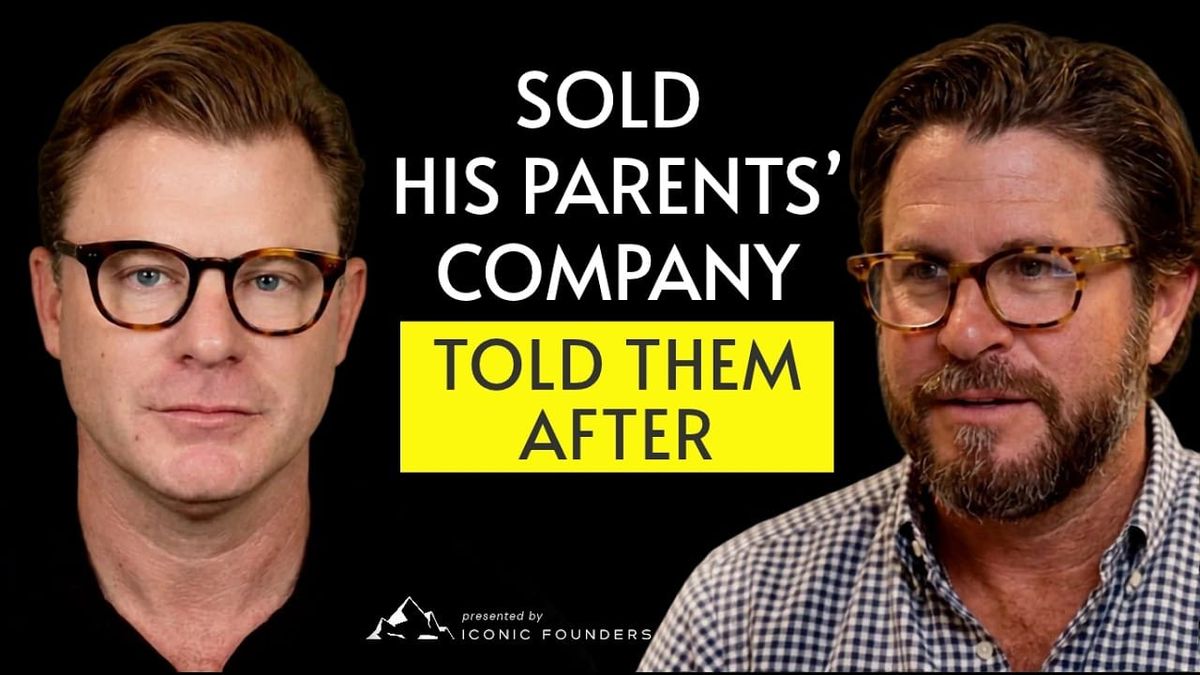
Family businesses are messy, and adding private equity to the mix often creates a powder keg. Erik Guggenheim shares his journey of scaling his family’s specialty carbon fiber construction firm and making the brutal decision to buy out his parents.
Operating a self-funded contracting business requires massive upfront capital for projects, a cash flow cycle that Wall Street analysts rarely grasp. Erik outlines how a seemingly lucrative exit transformed into a battle over project financing when backward-looking investors clashed with the demands of forward-looking construction contracts. He breaks down the friction of moving from a founder-led setup to a process-driven organization and the hard choices required to execute a complex buyout.
For operators navigating a generational transition or considering outside capital, this conversation provides a blueprint for surviving the structural friction. Subscribe and share this episode with a founder preparing for their own exit. How would you handle a major disagreement over scaling your family business?
Running a blue-collar business? Wondering how to think about value or selling? Iconic Founders Group helps founders like you explore what's next. If you're doing over $2M in profit, check us out at iconicfounders.com or send us a message at theturn@iconicfounders.com.
Iconic Links:
• Learn More: www.iconicfounders.com
• Connect: theturn@iconicfounders.com
More About this Episode
Navigating the Shift from Family Business to Private Equity Powerhouse
If you grew up in a family business, you know the reality of the dinner table dynamic. There is always an invisible guest sitting right there with you. Sometimes that guest is treated like a beloved sibling, sometimes like a bitter enemy, and sometimes like an incredibly demanding partner. That guest is the company. It dictates the mood, it drives the conversation, and it absolutely shapes your worldview.
For those of us in the construction, engineering, and specialty contracting industries, this dynamic is incredibly common. The vast majority of businesses in the trades start as family operations. They begin in a garage, scale up through sheer willpower, and rely heavily on the blood, sweat, and tears of relatives. But there comes a critical inflection point in the lifecycle of these companies. To survive and truly scale, a company must eventually transition from a family business into a fully mature, process-led organization.
When that transition happens, the door often opens to outside capital. Today, private equity is aggressively targeting the blue-collar space, looking for reliable returns in an unpredictable world. But bringing private equity into a specialty construction business is fraught with hidden dangers.
The Realities of the Family Operation
Growing up inside a contracting business provides a masterclass in work ethic. While other teenagers are working minimum wage jobs, kids in a family business are often running crews, managing heavy equipment, or handling back-office administration. You learn the value of a dollar quickly when you are pulling double overtime in the summer heat.
However, the flip side of that coin is the complete lack of boundaries. Because you are family, the expectation is that you will work twice as hard for the legacy of the company. You bring the work home, you discuss it over holidays, and you cannot easily separate your personal identity from the corporate entity.
This environment breeds incredible operators but often fails to build sustainable corporate structures. A founder might be an absolute genius at their craft. They might be an academic inventor who developed a revolutionary way to reinforce concrete with carbon fiber, or a master builder who understands paving better than anyone in the state. But being a genius in the field does not automatically translate to being a genius at organizational scale.
Many founders rely entirely on their personal networks. Their customer relationship management system is nothing more than a physical map book and a stack of business cards collected over three decades. When a business relies entirely on the founder's intuition, relationships, and physical presence, it is fundamentally fragile. It is a time bomb waiting to go off, even if the balance sheet looks incredibly healthy today.
Transitioning from Founder-Led to Process-Led
The most difficult hurdle for any family construction business is making the leap from a founder-led model to a process-led model. A business cannot scale nationally or regionally if every major decision has to pass through the original founder.
Making this leap requires stripping away the informality of the family dynamic and replacing it with rigorous corporate structures.
- Implementing True Sales Training: You can no longer rely on the founder's charm or historical relationships to win bids. You need a replicable sales system that a brand new hire can learn and execute.
- Standardizing Operations: Every project must follow the exact same operational procedures, regardless of which crew is deployed. This is especially vital in specialty contracting where safety and precision are non-negotiable.
- Establishing a Fiduciary Board: This is perhaps the most crucial and painful step for a family business. Bringing in a board of directors with heavy outside experience changes the power dynamic completely.
A fiduciary board serves a vital purpose. In a family business, you often have a mix of ambitions. One sibling might want to push the company to go full speed and expand aggressively, while the parents might want to slow down and protect their nest egg. A young, hungry executive needs to be guided. A board of directors can reign in that unbridled ambition, preventing the young leaders from running a race they do not fully understand yet. More importantly, an objective board takes the emotional sting out of hard business decisions, stopping the family from fighting in front of the human resources department.
The Private Equity Boom in the Blue-Collar Space
Once a specialty contracting business matures and establishes process-led operations, it becomes a massive target for acquisition. Right now, private equity firms are swarming the construction, HVAC, paving, and specialty engineering sectors.
The reasoning behind this gold rush is simple. Investors are desperately trying to diversify their portfolios away from industries that artificial intelligence might replace. You cannot use a computer algorithm to physically reinforce a failing concrete bridge. You cannot use software to lay down miles of asphalt. The trades provide essential, physical services that are entirely AI-proof.
When private equity looks at a specialty contractor, they often see a perfect acquisition target. They look at a company utilizing advanced technology, like carbon fiber structural reinforcement. They see a service that can go into a hospital, reinforce the concrete floors over a single weekend to support heavy MRI equipment, and do it without shutting down the hospital's operating rooms. That level of efficiency commands high margins.
The Great Disconnect: Where Private Equity Fails in Construction
On paper, the marriage between private equity and specialty contracting looks flawless. The private equity firm looks at the trailing twelve and twenty-four months of revenue and sees beautiful, high-margin returns. They look at the forward horizon, see crumbling infrastructure across the country, and project massive future growth.
But this is exactly where so many private equity firms get the construction industry completely wrong. They evaluate the business as if it were a pure technology or software company, fundamentally misunderstanding the incredibly capital-intensive nature of project financing.
Construction and specialty contracting are entirely different beasts than software. When a major contractor wins a massive bid, they do not just start collecting subscription revenue. They have to fund the project upfront.
Consider the reality of a fifty million dollar contract. To execute that job, the contracting firm might need to float fifteen or twenty million dollars in upfront costs for materials, specialized labor, and equipment logistics. They have to carry that massive financial burden for weeks or months before the first payment milestones are reached.
For a self-financed family business, this cash flow cycle is intensely stressful. You might be highly profitable on paper, but you are constantly just weeks away from a major cash crunch if a client delays a payment.
When a private equity firm buys into this model, they are often entirely unprepared for these capital calls. The private equity board looks at the financials and suddenly panics. They see millions of dollars going out the door to fund a project, and they feel like they are upside down on their investment. They start questioning why they have to inject more working capital into a company that was supposed to be a cash cow.
They fail to understand that in the construction world, you have to buy the materials before you can build the structure. You get the money back with a high margin in ninety days, but the waiting period terrifies traditional financial analysts who are used to predictable, recurring revenue models. This fundamental misunderstanding creates massive friction between the operational leaders who know how to build and the financial sponsors who only know how to read a spreadsheet.
Using Private Equity for the Ultimate Buyout
The friction between different generations in a family business can sometimes reach a breaking point. When the original founders refuse to adapt to a changing market, or when they refuse to let go of the reins so the company can scale, drastic measures are sometimes required.
In some cases, the only way forward is to leverage outside capital to force a transition. Using private equity and debt restructuring to buy out family members is an incredibly difficult maneuver. It is the business equivalent of a hostile takeover at the dinner table.
When visions no longer align, someone has to make the hard, unpopular decision. Carving out a successful division, securing private equity backing, and executing a buyout allows the business to break free from the constraints of the founders' original vision. The family members are made financially whole, often walking away with significant wealth, but the emotional toll is massive.
It is a stark reminder that the company, that invisible guest at the dinner table, ultimately demands to be fed. It demands growth, adaptation, and structure.
Building a Bulletproof Strategy
If you are running a family business in the trades and you have your eyes on an eventual exit, you have to start preparing years in advance. You cannot simply hand over a map book of contacts to a private equity firm and expect a premium valuation.
You must transition your operations today. Build the sales training programs. Document every standard operating procedure. Take the personal magic of the founder and turn it into a repeatable system that any competent manager can run.
Furthermore, if you are considering bringing in a private equity partner, you must rigorously interview them. Do not just look at the size of the check they are writing. You must ensure they fundamentally understand project financing, the cost of materials, and the cyclical nature of construction cash flow. If they evaluate your heavy engineering firm like a software startup, they will panic the moment you need to float ten million dollars for a commercial job.
The transition from a scrappy family operation to a corporate powerhouse is one of the most challenging journeys an entrepreneur can take. It requires breaking old habits, challenging the people you love the most, and bringing in outside forces that will fundamentally change the DNA of the company. But if done correctly, it is the only way to build a legacy that outlasts the founders and truly dominates the market.

Member discussion: